
Storing a memory is easy. Auditing the decision to keep, show, use, and later trust it is harder.
An agent can summarize a conversation, save the result, and retrieve a similar record next month. The difficult questions arrive later: why is the record still present, is it still true, does it conflict with another memory, who was allowed to see it, and which answer or action used it when it was wrong?
Recent long-term memory research treats memory as an auditable selection problem rather than a larger storage layer. That shift matters for products because a final answer score cannot tell us whether the memory was written well or whether retrieval and reasoning happened to compensate for a bad write.
Memory writing needs its own evaluation
Published in May 2026, MEMAUDIT proposes evaluating what a memory writer keeps under a fixed budget before future queries are known. Its protocol separates representation quality, preservation of validity state, and budget-aware selection. In other words, the question is not only whether an agent can answer later. It is whether the memory system made a defensible decision before it knew what later work would ask for.
Learning What to Remember, published in June, argues that recency and simple semantic similarity are not enough to decide what should be forgotten. Reliability, goal relevance, user relevance, and task utility also matter. In its limited blind-regime experiment, the learned multi-factor method retained 0.770 ± 0.011 of gold evidence, compared with 0.657 for uniform weights and 0.368 for recency. That is not a universal law for every agent. It is evidence that forgetting deserves a separate evaluation.
SubtleMemory makes a related point with 1,522 evaluation instances and 1,090 relation-controlled sets. It tests memories that complement, change, or contradict one another and reports that current systems remain weak at fine-grained relational discrimination.
The sources therefore support a cautious conclusion: long-term memory quality includes what a system preserves, what it marks as uncertain, and how it handles relationships between records. It is not just a retrieval hit rate.
A memory is a claim with state
In product terms, a memory is not merely a piece of text. It is a claim with a history and a scope.
| Field | What an audit should be able to answer |
|---|---|
| Provenance | Where did the record come from, and when was it created? |
| Type | Is it a fact, preference, instruction, observation, or inference? |
| Validity | Which project, task, user, and time window make it applicable? |
| Relationship | Does it support, update, or contradict another record? |
| Use | Which answer, decision, or tool action later relied on it? |
| Access | Who or which agent was allowed to see the projection? |

Long-term memory is not a list of stored facts; it is a process for comparing states and making decisions.
When memories conflict, overwriting one with the newest record is often less useful than preserving the relationship and the need for confirmation. A recent statement can be wrong. An older statement can be out of scope. Without validity and provenance, the retriever has no reliable way to tell the difference.
Luthn separates storage from agent visibility
Seen through this lens, Luthn is a practical safe-context example. Luthn does not pass raw source data into an agent’s default context. It classifies and redacts intake, then exposes separate safe summaries and context that are eligible for agents. Storage and agent visibility are treated as different decisions, and external publication requires its own explicit approval.
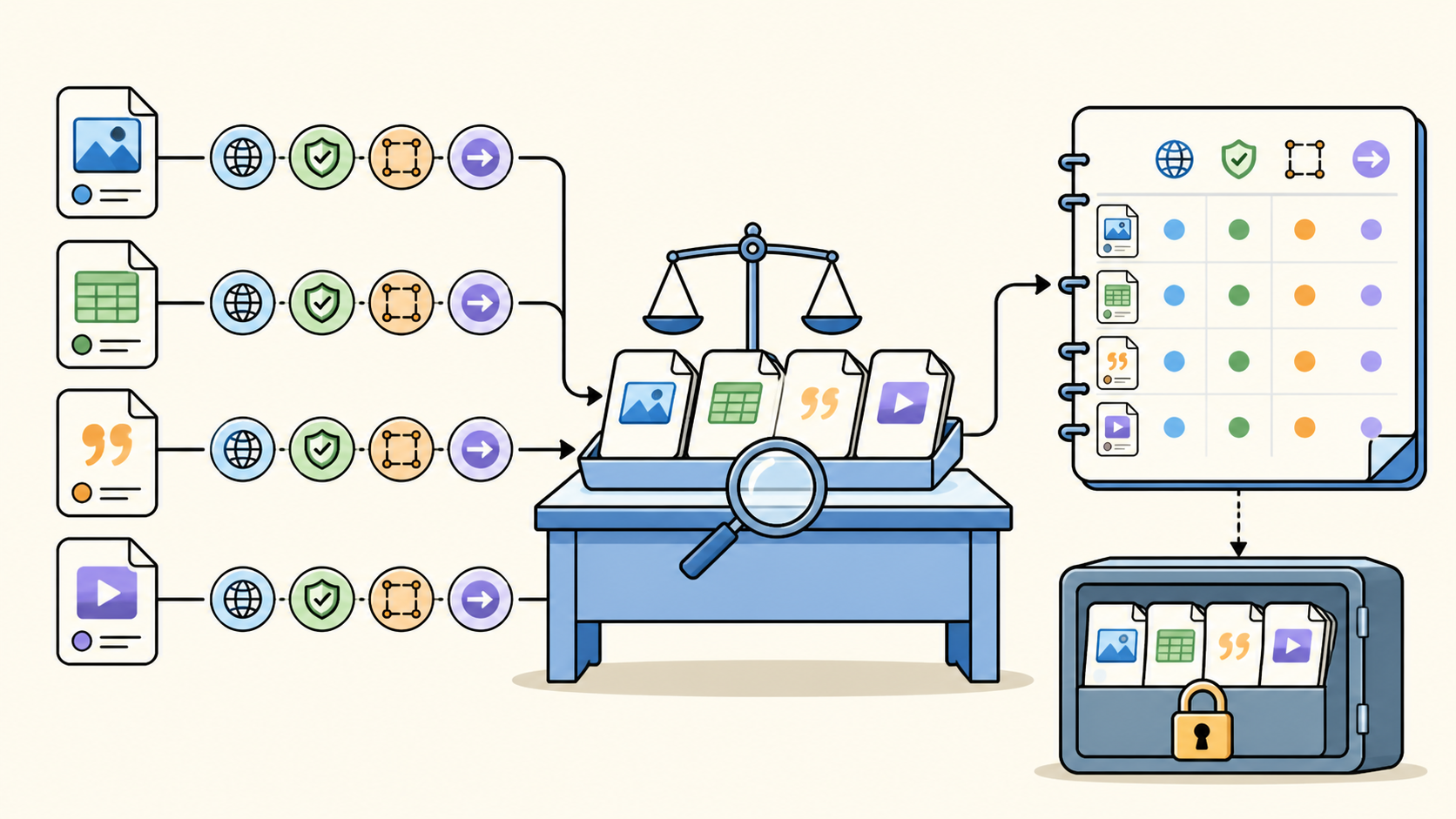
A useful audit trail preserves the decision metadata without becoming a second copy of the protected source.
Its public design also keeps the audit trail at the level of storage, sharing, retrieval, decisions, and failures rather than making a transcript archive or a way to recover the original record. That separation matters because the operational question is not only “what did the agent remember?” but also “why was this memory visible?”
This does not mean Luthn solves every memory problem. It shows why classification, safe projection, access authority, and audit records should not be collapsed into one feature. The system should be able to say that a projection was expired or refused without returning the protected source as a consolation.

Memory policy quality becomes visible when selection, refusal, provenance, and authority decisions are compared under the same conditions.
A minimum experiment for comparing memory policies
When introducing a memory policy, it is difficult to judge it from the impression that final answers improved. A better comparison uses the same task records under three conditions: a no-memory baseline, bounded memory that retains provenance and validity, and the broader retrieval policy already in use. Giving each condition the same questions and tool authority makes the effect of memory easier to observe.
The metrics should not stop at answer accuracy. Record whether the selected memory has complete provenance, whether the system asks for confirmation instead of presenting a stale fact as current, whether it distinguishes conflicting records, whether it hides memories outside the requester’s scope, and whether there is evidence that a memory influenced a later answer or tool call. Not using an incorrect memory should count as a successful outcome.
The test set can include a changed preference, a project whose scope has shifted, a request with only partial access, and an ambiguous question that should escalate. Reviewers inspect the selected and refused memories, expiry state, and authority decision as well as the final sentence. The evaluation artifact should keep identifiers and summaries rather than copying personal data or protected source text.
This experiment does not guarantee that one policy improves every agent. It does make the comparison about what the memory system selected, what it deliberately did not use, and whether the decision can be explained later—not only about how much it stored.
What an audit should answer
An operator does not need to reread every conversation. A bounded audit should be able to answer at least four questions:
- What source and classification produced this memory?
- Under which owner, project, task, and expiry was it valid?
- Which agent or requester received it, and under what authority?
- Did it influence a later answer or tool action, and what happened next?
Copying raw source material into the audit trail creates another sensitive store. Leaving no record makes an incorrect memory impossible to investigate. The useful middle ground is compact, queryable metadata with a clear link to the decision and no unrestricted path back to the source.
The cited papers and public Luthn documentation give a design direction, not a local controlled A/B result. I have not measured that one memory policy improves every agent. The stronger claim is more modest: as long-term memory grows, validity, provenance, access, and use history need to be evaluated alongside retrieval quality.