OpenAI has revised GPT-5.6 pricing just three weeks after launch. Effective July 30, 2026, API pricing for GPT-5.6 Luna, the least expensive model, fell by 80%, while pricing for GPT-5.6 Terra, the balanced model, fell by 20%. Standard pricing for Sol, the highest-performance model, remains unchanged.
On the surface, this looks like a straightforward discount. But Luna’s price dropped to one-fifth of its previous level in a single move, and OpenAI attributed the reduction to efficiency improvements across the model, inference system, and agent execution environment. That makes the change worth a closer look.
What Got Cheaper, and by How Much?
For API usage, Luna’s price fell from $1 to $0.20 per million input tokens and from $6 to $1.20 per million output tokens. Terra dropped from $2.50 to $2 for input and from $15 to $12 for output. Sol remains at $5 for input and $30 for output.
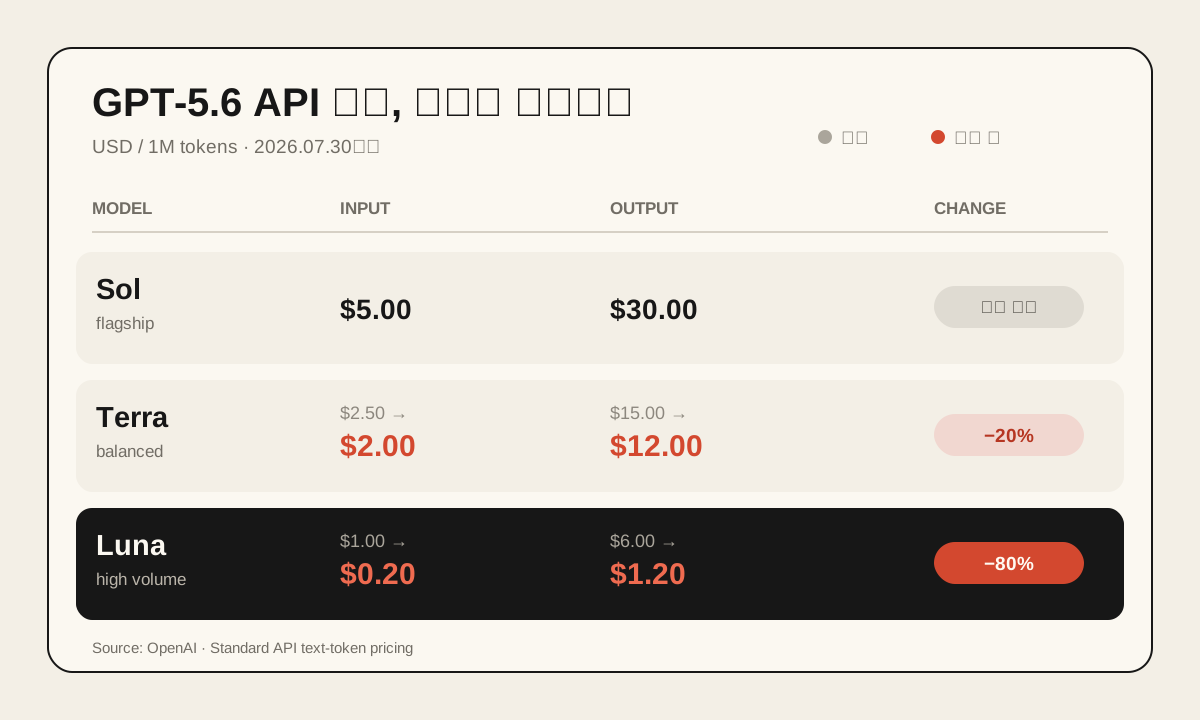
Prices are in US dollars per million API text tokens. Sol’s Standard pricing did not change.
ChatGPT and Codex subscription prices and overall usage limits have not changed. Instead, Terra and Luna consume fewer credits when used with a paid subscription. For developers, that means handling more requests on the same budget. For subscribers, it is closer to being able to continue the same work for longer.
Developers Immediately Began Calculating Where Luna Would Fit
The community’s initial response has been quite positive. In discussions on r/OpenAI and r/codex, developers said they were considering moving high-volume tasks such as summarization and classification from GPT-5.4 Nano or Mini to Luna. People already using Luna for everyday coding or as a working model for background agents said the reduction made it practical for a wider range of tasks.
The change is especially significant for repetitive work. A division of labor in which a higher-end model such as Sol handles planning and difficult decisions while Luna takes on clearly defined implementation, testing, and summarization is now possible at a far more practical cost.
There have also been cautious responses. Some developers want to confirm that performance remains the same after the price cut and that capacity will hold up under heavier demand. Others question whether a reduction as large as 80% comes entirely from efficiency gains, or whether it is also a strategic response to competing models or an effort to increase Luna adoption.
These reactions are early community opinions, not the results of a formal study. Still, one trend seems clear: developers are becoming more sensitive to the cost of completing a real task than to a model’s highest benchmark score.
Lower Prices Are the Most Powerful Way to Build an Ecosystem
In my view, OpenAI has done more than introduce a cheaper model. The move looks more like an effort to lower prices, bring in more developers and users, and get a wider variety of real work running on OpenAI’s models and tools.
As the developer base grows, model usage is not the only thing that increases. Practical knowledge accumulates about where models get stuck, which tool integrations are needed, and how different models should be combined. By “absorption,” I do not mean taking users’ private data. I mean a product strategy in which capabilities and working methods validated in the market are quickly integrated into OpenAI’s products.
The boundaries among ChatGPT, Codex, and the API have also been drawing closer. Features discussed across the market—tool calling, computer use, long-running tasks, collaboration among multiple agents, and external service integrations—are converging in a single environment. OpenAI appears to be aiming to become not just the company with the best model, but a platform that encompasses the way people work with AI.
This Could Be the Beginning of OpenAI’s Preparation for True AGI
I think this trend may be part of how OpenAI begins preparing for true AGI. AGI is unlikely to emerge from a single model with high benchmark scores alone. Many different people need to be able to assign real problems to AI, have it use the necessary tools and context to produce results, and run that process repeatedly at a manageable cost.
Lower prices increase the number of those repetitions. More developers and users can attempt more problems, while successful capabilities and working methods can be integrated back into ChatGPT, Codex, and the API. It creates a cycle in which model intelligence, tools, and human expertise circulate within one environment.
Of course, a price cut alone is not proof that AGI is closer. This announcement is, strictly speaking, about cost and efficiency. It can nevertheless be read as a sign that OpenAI is building not only “more capable models,” but also an ecosystem in which more people can put intelligence to practical use and improve how it is applied.
Luna’s 80% price cut has significantly widened the entrance to that ecosystem. The more important question is not how low token prices go, but what tools and ways of working will be built on top of those prices—and then find their way back into ChatGPT.