OpenAI’s August 6 update was easy to read as a model announcement. GPT-5.6 Sol was improved in ChatGPT, GPT-5.6 Luna was expanded to Free and Go users, and the chat product received a new reasoning slider and Think button.
There is one important boundary in that announcement: the release applies to the ChatGPT chat experience. OpenAI’s release notes explicitly say that Work and Codex are not changing as part of that update.
That does not mean Codex has stopped moving. It means Codex is on a separate update track, and the most interesting changes are increasingly about the environment in which a coding agent works.
GPT-5.6 is already a Codex choice
OpenAI’s GPT-5.6 launch post says that the family is available across ChatGPT, Codex, and the API. In Codex, Free and Go users get access to Terra, while Plus, Pro, Business, and Enterprise users can choose among Sol, Terra, and Luna. The max reasoning setting is available to users with GPT-5.6 access, and ultra is available in Codex to Plus and higher plans.
The Help Center currently lists minimum versions for GPT-5.6 access in Codex: ChatGPT desktop app version 26.707.30751 or Codex CLI version 0.144.0. Those version numbers are operational details, but they matter more than a benchmark headline when a team is trying to reproduce a workflow.
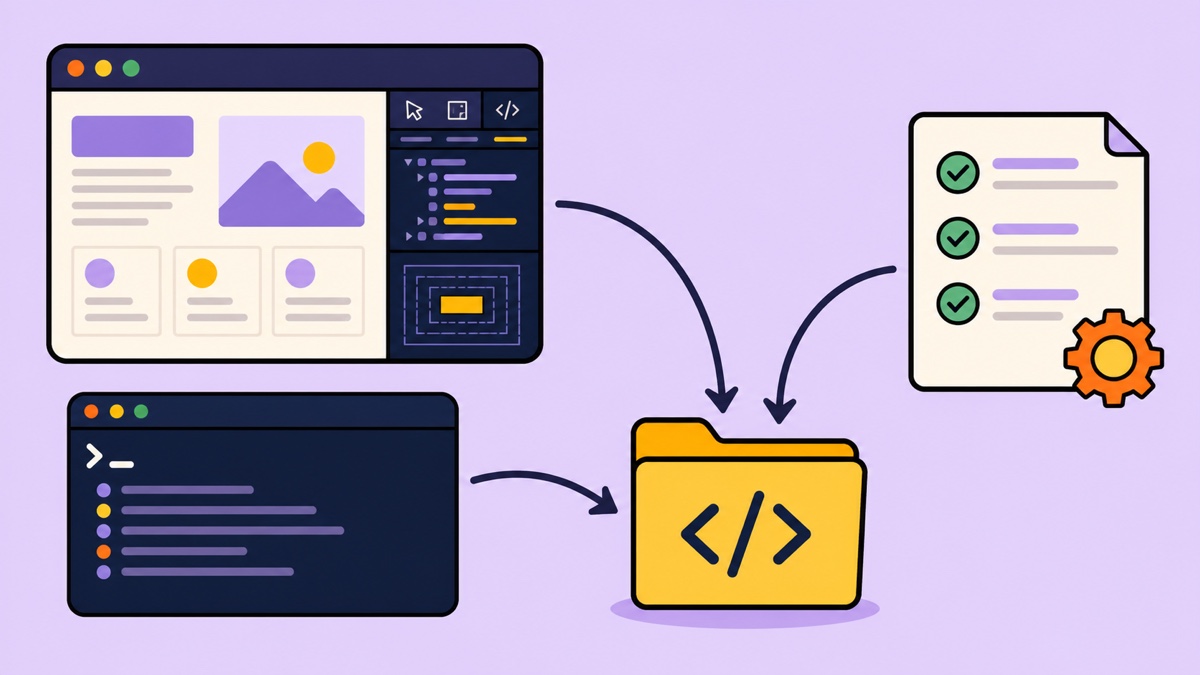
Codex is becoming a connected work surface for browser, terminal, and project context.
The recent updates are about the work around the model
OpenAI’s release notes list several Codex changes that are easy to miss when attention is fixed on model names.
Developer mode gives Codex controlled Chrome DevTools Protocol access in Chrome and in the Codex in-app browser. It can inspect console output and network traffic, review the DOM and applied styles, and diagnose live browser issues. The feature is off by default.
The same release added the /init command for generating an AGENTS.md project-instructions scaffold. Earlier updates made Codex Remote generally available on ChatGPT plans, allowing users to start or continue work on a connected Mac or Windows host from a phone, review progress, and approve actions. Record & Replay also lets eligible Mac users demonstrate a workflow once and turn it into a reusable skill.
These are not interchangeable features. Browser inspection helps with diagnosis. /init makes repository rules easier to establish. Remote access changes where work can be supervised. Record & Replay changes how a repeated workflow can be captured.
What is actually changing
My reading is that Codex is becoming less like a model picker and more like a controlled development environment. The model still matters, but so do the browser, terminal, repository instructions, remote host, approval boundary, and reusable workflow around it.
That is also why the August 6 ChatGPT update should not be described as a Codex model update. The official note says Codex is unchanged in that release. The accurate story is more useful: ChatGPT is receiving a chat-focused model update while Codex continues to evolve through its own tools and work surfaces.
For developers, the practical question is no longer only which model is strongest. It is which combination of model, browser access, repository context, remote control, and approval rules lets the agent finish a real task without losing the thread.