On August 5, Google announced a significant change at the center of its AI organization. Demis Hassabis will become Chair of Google DeepMind and Chief Scientist of Alphabet. Koray Kavukcuoglu will take over as Senior Vice President of Google DeepMind, with responsibility for Gemini model development, frontier research, and the Gemini app and developer teams. Jeff Dean and Sanjay Ghemawat will also leave to build an independent public benefit corporation focused on machine learning, science, and engineering. Google’s announcement
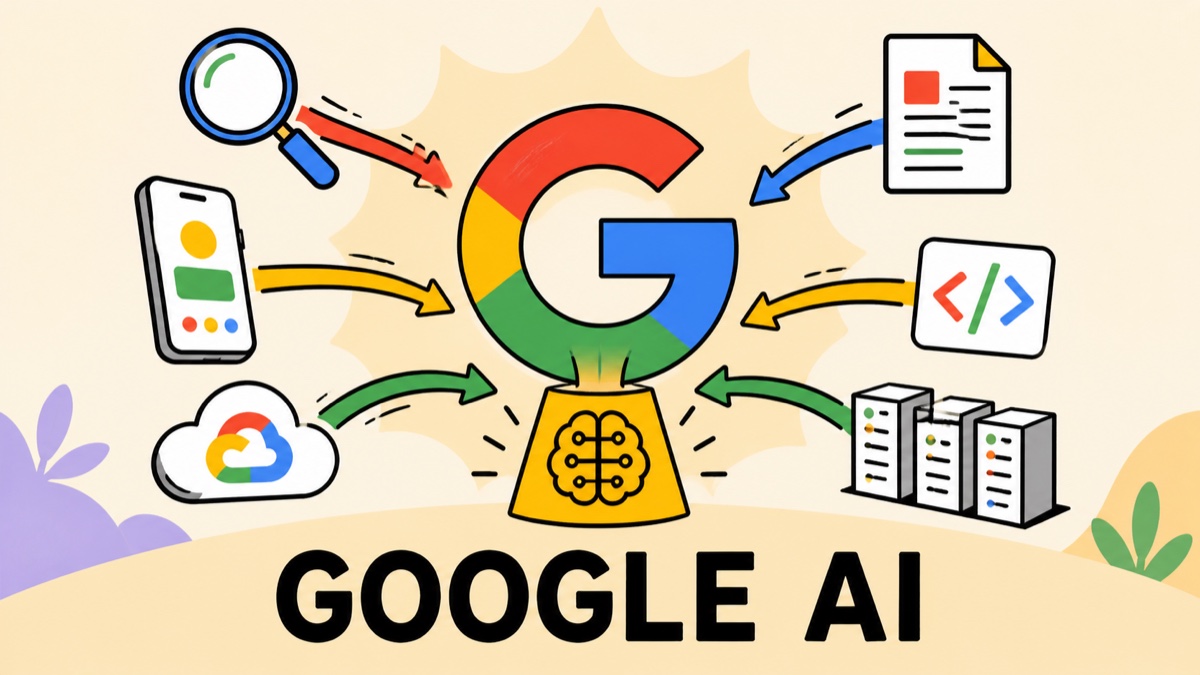
The announcement is written as a deliberate next chapter. But it raises a larger question: does Google’s enormous ecosystem help its AI grow, or does it make the company too difficult to focus? Google has Search, Android, Workspace, Cloud, data-center infrastructure, custom chips, and a huge developer surface. It has more ways to distribute AI than almost any other company. Yet OpenAI and Anthropic often receive the clearest market attention because their AI products have a simpler story: one company, one model family, one obvious place to start.
That contrast is the part of this news I find most interesting. Google may not need to become another OpenAI or Anthropic. It may need to turn its complexity into a single, repeatable way for people and developers to use intelligence every day.
What actually changed at Google DeepMind
The formal facts matter before the interpretation. Hassabis is not leaving Google. He will continue to lead Isomorphic Labs, remain involved with Google DeepMind, and move toward a role centered on long-term science and AGI. Kavukcuoglu will own more of the day-to-day operating responsibility across models, research, the Gemini app, and developer products. Dean and Ghemawat are starting a separate company, while Google says it will remain a founding investor, cloud partner, and research-framework partner. The official memo
Axios described the change as part of a broader effort to keep pace with OpenAI and Anthropic. That is a source-reported framing, not proof that Google has lost the technical race. It does show how the market is interpreting the move: Google is not being judged only by its research capacity. It is being judged by whether it can turn that capacity into products that people notice, choose, and use repeatedly. Axios’s report

Demis Hassabis in 2025. Photo by Christopher Michel, used under CC BY-SA 4.0 via Wikimedia Commons. The portrait is reproduced without modification.
The ecosystem is Google’s biggest advantage
Google’s ecosystem gives it several structural advantages. A model can reach users through Search, Android, Workspace, Cloud, and developer tools without waiting for an entirely new distribution channel to be built. Google also controls or operates important parts of the stack beneath those products: data-center capacity, custom accelerators, research organizations, and software platforms.
That combination can create a powerful feedback loop. A model improves, more people encounter it in products they already use, developers build integrations around it, and the resulting usage reveals which capabilities matter in real work. A company that can connect research, infrastructure, distribution, and workflow has the ingredients for an unusually durable AI business.
This is why I would not describe Google’s ecosystem as a weakness by itself. It is a moat. The problem is that a moat is not the same thing as momentum. Distribution can make a product available everywhere without making it the product that people actively seek out.
Why the same ecosystem can make AI look smaller
A broad ecosystem also creates obligations that a focused AI company does not have. Google has to think about the effect of AI on Search, advertising, privacy, trust, enterprise contracts, Android partners, and existing product teams. A new capability cannot always be launched as an unconstrained experiment. It has to fit inside a much larger set of business and safety decisions.
This can produce a strange market impression. Gemini may appear in many places, but users may not know what the central Gemini experience is supposed to become. A model can power a feature in Search, a writing assistant in Workspace, a coding tool in Cloud, and a mobile assistant on Android. Those integrations are valuable, but the total can still feel like a collection of features rather than a single product with a strong habit loop.
OpenAI and Anthropic benefit from a simpler narrative. Their products may have their own strategic and technical complexity, but the public can more easily identify the main interface and the main promise. That clarity creates attention, developer experimentation, and a steady stream of comparisons. It does not automatically mean the focused company will win, but it makes momentum easier to see.
What this leadership change may be trying to solve
The new structure appears to separate two jobs that are often difficult to perform at the same time. Hassabis can spend more energy on long-horizon research, AGI, and scientific direction. Kavukcuoglu can concentrate on model delivery, product execution, and the developer path. In theory, that is a sensible division: one leader protects the frontier while another makes sure the frontier reaches users.
The risk is that the separation becomes another layer of coordination. A focused AI company can often make one decision and ship it across its product. Google has to make the decision, align multiple organizations, consider existing businesses, and then decide how much of the result should be exposed to each surface. The new structure will be meaningful only if it shortens that path rather than adding another title to the organization chart.
Dean and Ghemawat’s new venture adds a second signal. Google is confident enough to remain an investor and partner, but two of its most important long-term engineers will now build outside the main company. That can be healthy for the broader ecosystem, while also reminding Google that talent and initiative do not have to remain inside a large organization to create important AI work.
Can Google become the AI company the market is waiting for?
I think it can, but not by copying OpenAI or Anthropic. Google should use its ecosystem to create a different kind of leadership: a company where the model, the distribution layer, the compute infrastructure, and the daily workflow reinforce one another.
Three conditions will matter.
First, Gemini needs to become a clear product identity rather than a label attached to many features. Users should understand what they can ask Gemini to do, where the work continues, and why the experience is better because it is connected to Google’s services.
Second, Google needs to measure ecosystem strength by behavior rather than by the number of integrations. The meaningful signals will be repeated use, tasks completed across products, developers building on the platform, and users choosing Gemini when they have a choice. Preinstallation and visibility are useful, but they are not the same as preference.
Third, the AI organization needs enough independence to make uncomfortable product decisions. If a capability threatens an existing habit, changes an advertising surface, or forces several teams to work differently, someone still needs clear authority to decide that the AI future is worth the disruption.
My conclusion
The question is not whether Google’s ecosystem is too large for AI. The more useful question is whether Google can make that ecosystem feel like one coherent AI platform instead of a set of powerful but disconnected channels.
Google has assets that OpenAI and Anthropic cannot easily reproduce: enormous distribution, deep infrastructure, research depth, and access to workflows that already matter to billions of people and businesses. But those assets only become leadership when they produce a faster learning loop and a clearer user habit. Otherwise, the ecosystem becomes something Google has to protect rather than something that helps it move.
The leadership changes announced this week are therefore neither proof of failure nor proof of a new victory. They are a test of whether Google can give long-term AI science and fast product execution enough focus to work together. I would watch the next Gemini releases, developer adoption, and the number of genuinely repeated cross-product tasks—not just the number of places where the Gemini name appears.
Google can become a company that leads AI. But the winning version of Google AI will probably not look like a smaller OpenAI. It will look like Google finally making its entire ecosystem behave as if it has one clear AI purpose.