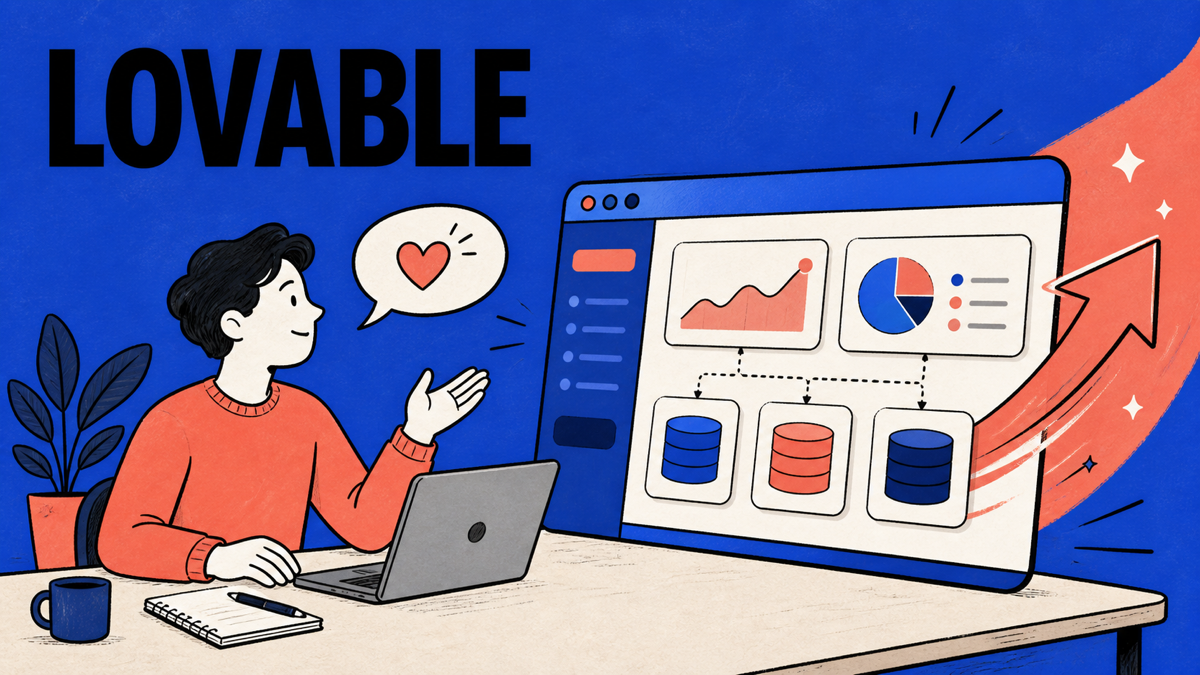
Lovable is an AI app builder that turns natural-language descriptions into websites and web apps. Give it a written brief, a screenshot, or a Notion document and it can connect not only the interface, but also authentication, databases, file storage, payments, and hosting. Lovable describes itself as an AI cofounder and development team. Its real value is less about making a pretty first screen than shortening the time from an idea to a useful test. You can start for free from the Lovable homepage.
Whose problem does it solve?
The problem is familiar. Non-technical founders, product managers, designers, and sales or operations teams may understand a customer problem and the feature they want, yet spend weeks or months finding a developer and translating the idea into requirements. A Figma file or slide deck cannot validate actual use, payments, or a workflow. An agency can also over-engineer the solution or deliver something too fragile. Lovable tries to reduce that translation cost so people can test an MVP, an internal tool, or a narrow customer workflow while the idea is still changing. In one company-published example, Yannis Karagiannidis built and launched the newsletter-customization micro-SaaS PrintPigeon in three days after hitting that exact problem.
Lovable was co-founded in Stockholm by Anton Osika and Fabian Hedin, growing out of the open-source project GPT Engineer. The company’s stated ambition is to let the 99% who do not code create software. In July 2026 it announced agent integrations: an app can expose an MCP server so ChatGPT or Claude can call approved functions. That moves the product from a screen a person opens toward a service an AI can query, submit forms to, or use to create reports. Anthropic’s 2026 State of AI Agents report also includes Lovable as a case study and, quoting the company’s own case metrics, describes 20x faster development and more than one million monthly active users after Lovable selected Claude.
Image: Official Lovable announcement image. Source: Lovable announcement
Cost and real-world reaction
As of August 2026, the Free plan includes five build credits per day, capped at 30 per month, plus 20 Cloud credits and 4 credits for AI features in deployed apps. Paid plans start at $25 per month for Pro with 100 credits and $50 per month for Business with 100 credits; annual billing is listed at roughly $21 and $42 per month. Build work, hosting, and AI features in the app draw from a shared credit balance, so the subscription price is not the same thing as the eventual operating cost.
The community response is mixed. The speed of the first prototype is compelling, but a recent Reddit discussion repeatedly raised authentication, databases, payments, permissions, edge cases, maintainability, and security after launch. TechRadar also found that a working app could arrive quickly, while warning that results can drift from the request. Lovable itself acknowledged and fixed an April 2026 permission regression in which chat history and source code from public projects could potentially be accessed. The current weakness is not whether an app can be generated, but whether its output can be reviewed and operated safely.
Market potential and limits
Lovable’s own Build Economy research says 80% of builders identify as non-technical and eight in ten respondents intend to monetize what they make. If that signal holds, the market can extend beyond landing pages into B2B SaaS, internal dashboards, marketplaces, and customer-facing automation. GitHub sync, code download, and a standard React, Supabase, and Tailwind stack give developers a path to take over as a project grows.
There are still limits: uneven generated-code quality, model misunderstandings, Cloud usage and credit exhaustion, security review, and vendor dependence. Lovable’s FAQ describes mobile delivery mainly through web apps, PWAs, and Capacitor rather than React Native. Lovable is therefore not a replacement for a product or engineering team. It is a way to reduce the time before that team is needed and to let a small team run more experiments. The long-term test is whether it can grow from an app generator into software infrastructure with durable permissions, observability, and operations.