Higgsfield started as an AI service that turns text or images into video. It is now closer to a production platform that wants to bring camera control, model selection, app building, and delivery into one workflow. The company calls it an “all-in-one AI creative studio” for creators, marketing agencies, and filmmakers. You can explore its models and proprietary tools from the Higgsfield homepage.
Whose problem does it solve?
When a team makes a short ad or music-video concept, it often moves between an image generator, a video model, an editor, and an upscaler, carrying prompts and character settings from one tool to the next. Camera motion can miss the brief, and a person can change from shot to shot. Higgsfield tries to reduce that translation cost by connecting text, images, lenses, camera movement, color, and character consistency in one flow. Social marketers, brand teams testing product ads, and filmmakers who need previsualization are its clearest first users.
Accel lists Alex Mashrabov, Yerzat Dulat, and Mahi de Silva as founders. TechCrunch describes Mashrabov as Snap’s former generative-AI lead. Higgsfield’s stated ambition is not simply to make one beautiful image; it wants video to be produced through fast, repeatable iteration. Its Supercomputer agent breaks a task into steps, chooses models and presets, and shows the credit cost before execution. The company combines its Soul and Cinema Studio tools with partner models so users do not have to compare every model name themselves.
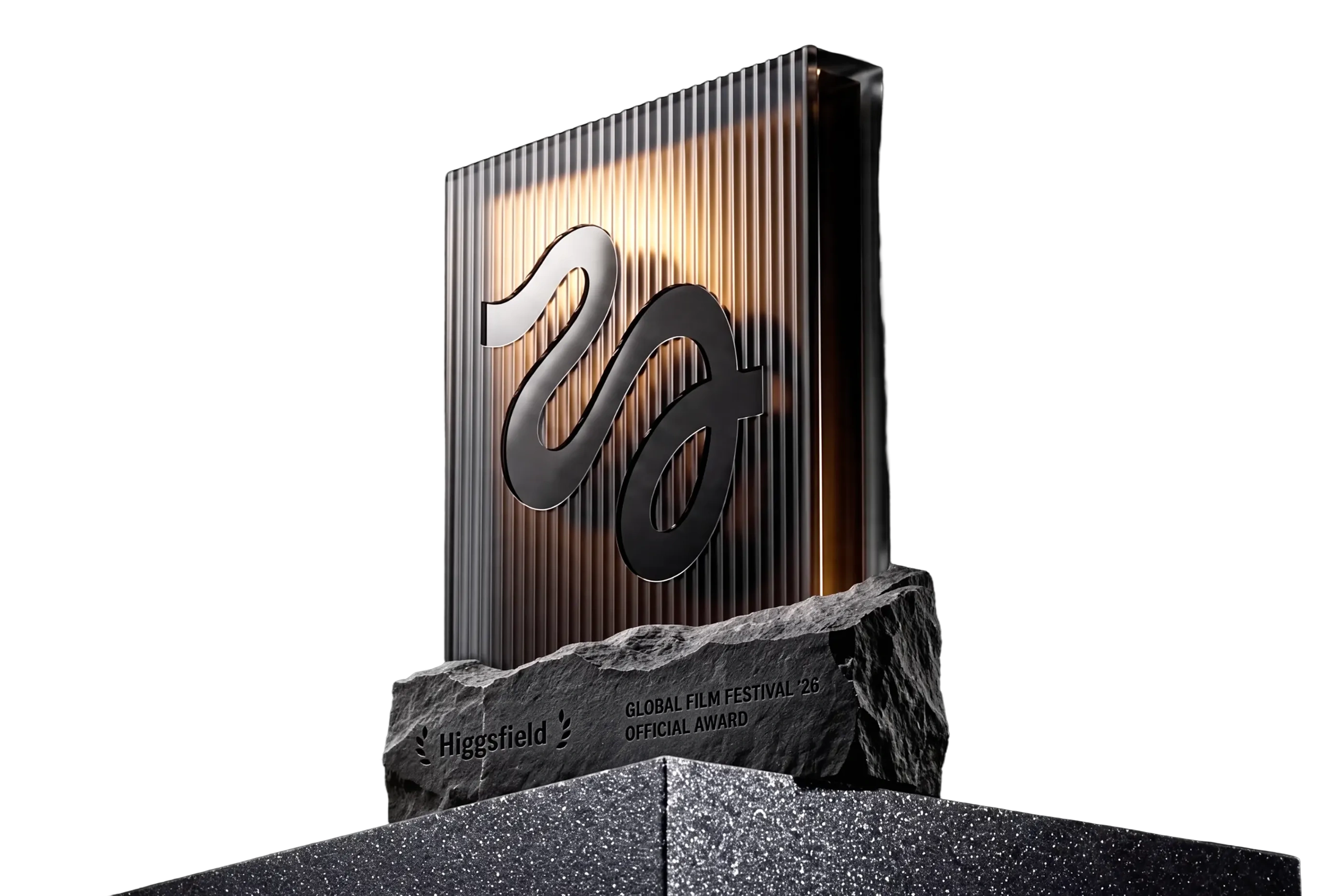
Image: Official Higgsfield Global Film Festival asset. Source: official festival page
Recent news and the reaction around it
On July 9, 2026, Higgsfield announced Apps, pushing the platform idea further. Users can describe a generative app in natural language and connect Higgsfield models, a database, and a front end. The company says the system includes more than 15 generation models and a marketplace with more than 500 apps. In August it opened the $1 million Global Film Festival, with Edwin Catmull—former president of Pixar and executive producer of Toy Story—among the judges. The company is building not only a product, but also a place where creators and finished work can gather.
The financing news needs a clear label. Axios Pro Rata reported on August 17 that Higgsfield had raised $400 million at a $5.4 billion post-money valuation. That figure has not been independently confirmed by a company announcement in the sources reviewed here. The company did publish a terms and privacy update in late July. Users retain ownership of inputs and outputs, but the service still receives a license to operate and may use content for training under the stated terms. “Commercially usable” does not automatically mean “excluded from training,” so enterprise customers need to review the available terms.
Pricing is really a credit-economics question. Higgsfield’s official Supercomputer guide gives an example of roughly 90 credits, or $4.50, for one image-to-video workflow and about 200 credits, or $10, for a longer end-to-end process. Plans, credits, and promotions can change. In one Reddit thread, users complained that model-specific costs were hard to see before reaching the generation button. Another reviewer liked the cinematic motion for quick ideas but found client delivery required more correction and regeneration. These are individual community signals, not a representative survey, but they point to two buying barriers: cost transparency and consistency.
Potential and limits
Higgsfield’s upside lies in owning the workflow rather than winning only on one model benchmark. If Apps, the creator marketplace, the film festival, and enterprise terms connect, a creator video tool could expand into advertising-production infrastructure. The risks are equally structural: reliance on several external models, credit exhaustion and ambiguous “unlimited” plans, likeness and brand rights, training policy, and uneven output quality. Runway, Kling, Seedance, and other competitors are moving quickly too.
The real test is not whether Higgsfield can produce one surprising clip. It is whether a working team can use it to shorten the path from idea to repeatable production, review, and delivery while keeping cost and rights predictable. For now, Higgsfield is best understood as a bet on becoming an AI video studio, not merely another video generator.