Korea’s AI story is no longer just about imported models. In July and August 2026, several domestic teams released models that are large enough to matter, open enough to inspect, or specialized enough to run in real products. The government’s second-stage Sovereign AI project also moved from four finalists to three teams after a process that combined benchmark tests, expert review, and user evaluation.
That is meaningful progress. It is not yet proof that Korea has become an AI leader. The harder question is whether semiconductor capability can become a lasting software and product advantage.
Four models, four different bets
LG AI Research released K-EXAONE 2.0 on July 31 as a 750-billion-parameter open-weight model under the Apache 2.0 license. LG reports a 70.1 average across 24 benchmarks, along with 94.4 on OpenAI-MRCR and 89.6 on Ko-LongBench. These numbers suggest a serious general-purpose model with an emphasis on long-context and Korean-language use, but they remain figures reported by the model maker.
SK Telecom’s A.X K2 takes a different route. Its official repository describes a 688-billion-parameter mixture-of-experts model with 33 billion active parameters. SKT reports 97.1 on AIME26, 80.5 on KMMLU-Pro, 91.6 on CLIcK, and 98.0 on the Telecom τ²-Bench. The mix is revealing: the company is presenting the model not only as a reasoning system, but also as a Korean and industry-facing tool.
Upstage’s Solar Open 2 is another open-weight bet: 250 billion total parameters and 15 billion active parameters. Its published results include 92.4 on LiveCodeBench, 86.2 on MMLU-Pro, an 85.4 Korean average, and 86.75 on Ko-GDPval. The practical attraction is not simply size. A sparse model can make deployment more manageable if the software stack, memory footprint, and serving cost are handled well.
Motif Technologies’ Motif 3 widens the comparison. Its official model card and technical report describe a 314-billion-parameter MoE model that activates about 13.2 billion parameters per token, with a 256K context window and roughly 12.5 trillion training tokens. It is an open-weight model with additional emphasis on Korean, reasoning, legal, and financial data. Artificial Analysis lists it at 47 on the v4.1.1 Intelligence Index. The interesting part is not simply that it leads the domestic snapshot; it is the attempt to combine frontier-scale capacity with a relatively small active computation budget.
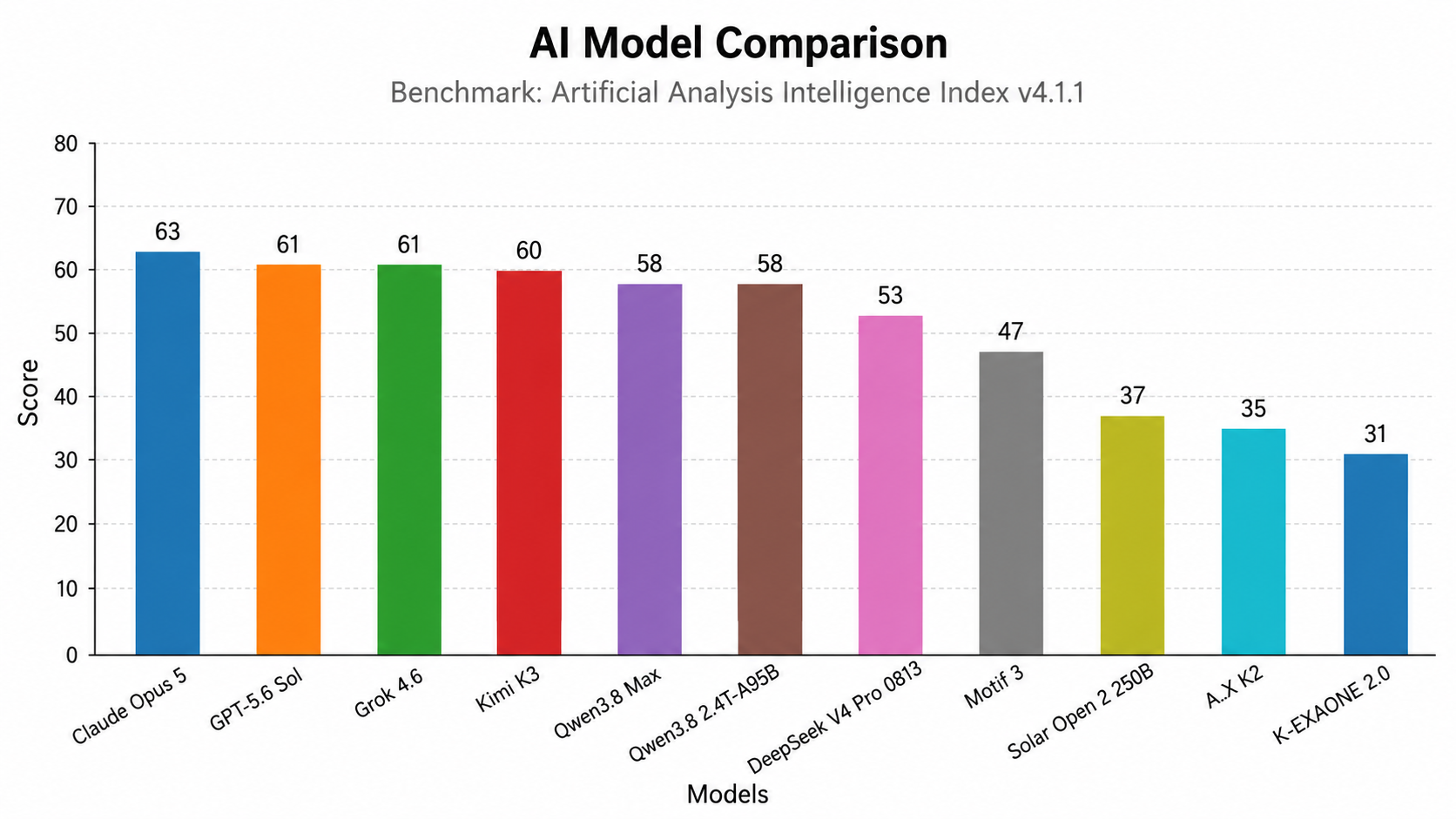
This is a point-in-time snapshot from the supplied comparison chart. Artificial Analysis scores and ranks can change with evaluation versions and release dates.
| Model | Public configuration | AAII score in the supplied chart | Other published result |
|---|---|---|---|
| Motif 3 | 314B / 13.2B active | 47 | 256K context, 12.5T training tokens |
| Solar Open 2 | 250B / 15B active | 37 | 92.4 LiveCodeBench, 85.4 Korean average |
| A.X K2 | 688B / 33B active | 35 | 97.1 AIME26, 98.0 Telecom τ²-Bench |
| K-EXAONE 2.0 | 750B | 31 | 70.1, 24-task mean; 89.6 Ko-LongBench |
This table should not be read as an absolute leaderboard. The four scores share the appeal of coming from the same AAII version, but Artificial Analysis also notes that the index does not directly apply to every use case. It is primarily an English-language, text-based suite; Korean, image, and speech capabilities are evaluated separately.
What the AAII score combines
Artificial Analysis Intelligence Index v4.1.1 combines nine evaluations into four weighted categories. Agents receive the largest share at 34%, followed by coding at 24%, scientific reasoning at 24%, and general capability at 18%. The result is not a generic knowledge quiz: it mixes tool use, code execution, long-document reasoning, factual reliability, and difficult academic questions.
| Benchmark | In brief |
|---|---|
| GDPval-AA v2 | Real-world knowledge-work and job tasks that produce file deliverables |
| τ³-Banking | An agent retrieves documents and performs multi-step banking actions with tools |
| Terminal-Bench v2.1 | Completing software, system, data, and security tasks through a terminal |
| SciCode | Solving scientific-computing problems in Python and passing tests |
| AA-LCR | Reasoning across multiple long documents totaling about 100K tokens |
| AA-Omniscience | Factual accuracy, hallucination control, and knowing when not to guess |
| Humanity’s Last Exam | Difficult academic questions across mathematics, humanities, and natural sciences |
| GPQA Diamond | Graduate-level biology, physics, and chemistry questions designed to resist simple lookup |
| CritPt | Research-level physics problems answered with equations, numbers, or Python |
This context matters when reading 47, 37, 35, and 31. Motif 3’s 47 means that it performed strongly across a composite suite; it does not mean its accuracy in Korean customer support or a specific factory is automatically 47. Likewise, K-EXAONE’s Korean and long-context strengths and A.X K2’s telecom and industry results are not fully captured by one composite number. Model selection still needs task-level evaluation.
Why the semiconductor base matters—and why it is not enough
Semiconductors give Korea an unusually strong starting position. Memory, HBM, packaging, manufacturing equipment, and relationships with large industrial customers can shorten the path from model research to hardware-aware services. A domestic team can ask a more concrete question than “Can we train a model?” It can ask which model should run at the factory, at the edge, or beside a company’s own data.
The A.X K2 announcement points toward manufacturing, national defense, and biotechnology as target areas. That is a company’s stated direction, not evidence that every listed sector has already adopted the model. Still, the direction is sensible. Korea’s advantage may not be winning every open-ended chatbot comparison. It may be building models that understand Korean documents, connect to existing industrial workflows, and operate under local data and cost constraints.
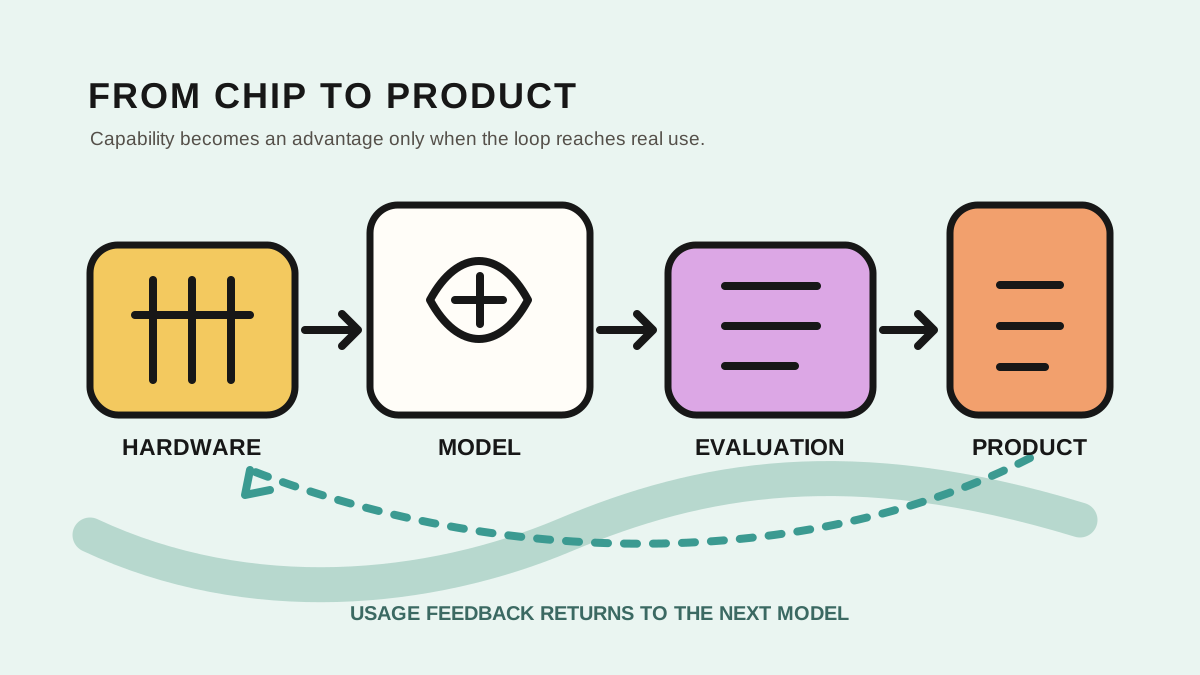
Hardware becomes an AI advantage only when usage feedback returns to the next model and product decision.
The risk is stopping at the press release. A high benchmark score does not automatically provide stable APIs, good documentation, quantized checkpoints, reasonable inference prices, evaluation that others can reproduce, or developers who want to build on the model. If those layers do not arrive, Korea can own capable models and still remain a spectator in the product market.
My bet is conditional
My view is that Korea no longer has to remain a third-party observer. The country has enough ingredients to produce visible AI results: compute and memory supply chains, large companies with real operating data, universities and model teams, and a public program willing to fund national-scale experiments. The recent releases show that the model layer is no longer empty.
But the failure scenario is equally clear. If the next year is measured only by parameter counts, a few benchmark peaks, and launch events, the advantage will fade. The decisive evidence will be less glamorous: how many teams ship products, whether customers keep using them after a pilot, how quickly developers can switch from a closed API, and whether usage data improves the next release without breaking trust.
So I would not call Korea an AI winner yet, and I would not call it a failure. I would call it a country at the point where its hardware strength has to learn product discipline. The benchmark chart is a signal. The real result will be the feedback loop after the chart: models used, costs paid, mistakes measured, and better systems shipped.