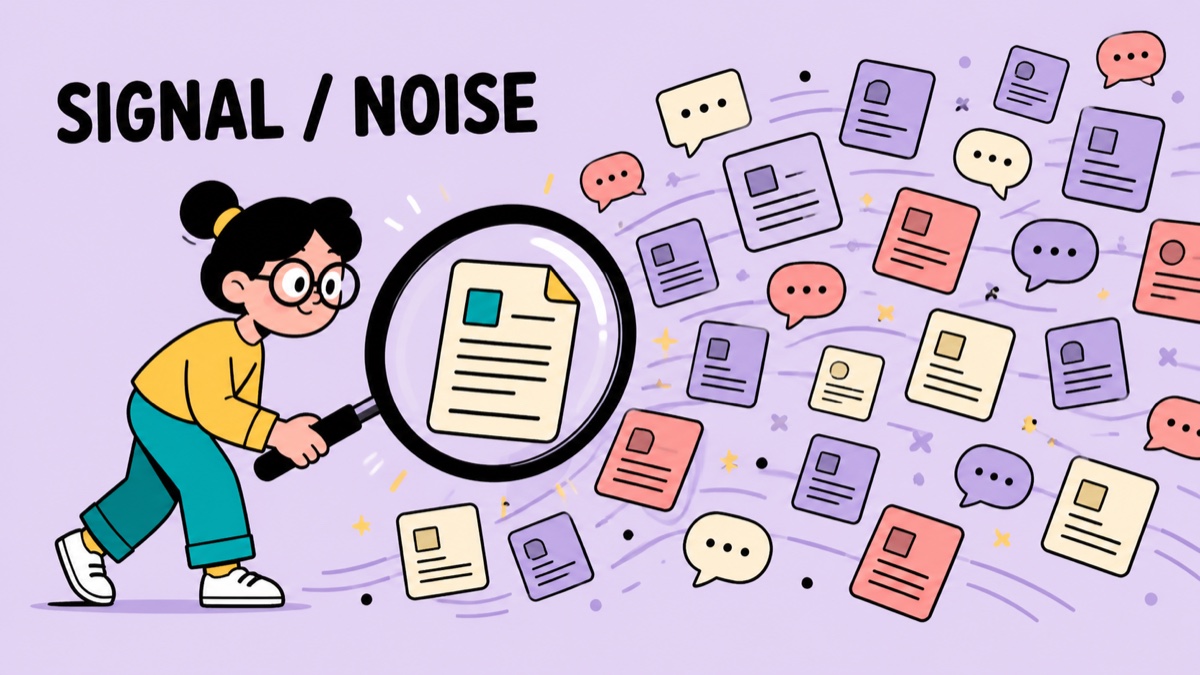
When people say AI slop, they often mean useless automatically generated material. Used that broadly, the term hides the shape of the problem. Researchers at the University of Miami describe prototypical AI slop through superficial competence, asymmetric effort, and mass producibility. They also argue that not every AI-generated work is simply digital trash, and that slop can have social and cultural functions.
That distinction matters. The presence of an AI-generated summary, image, or tutorial does not determine its quality. A smooth sentence and a large amount of information do not establish trust either. The recurring complaint in technical communities is less that generated work exists than that useful records are becoming harder to distinguish from similarly shaped filler.
More information does not always make discovery easier
As the cost of generation falls, the supply of content rises quickly. Short product summaries, repeated benchmark explanations, technical posts that summarize other summaries, and example repositories that were never actually run can all enter the same feed. This is not proof that every developer community has already degraded. It is a reminder that more information and a better signal ratio are different things.
The reader’s cost changes too. Instead of spending most of the time finding material, they may spend it checking whether the material reaches an original source, whether anyone verified it, and whether the result can be reproduced. The cost has moved from reading to verification.

The useful difference is not the amount of generated material but whether its source and verification path remain visible.
Numbers and fluent prose do not guarantee signal
When AI-generated content enters technical discussion, numbers can become decorations for trust. A benchmark score, view count, star count, or citation count can make a post look tested. Without the original data and execution conditions, however, a number is still a claim rather than a conclusion.
A Nature paper argues that accuracy-centered evaluations can encourage a model to guess rather than admit uncertainty. The paper does not measure AI slop directly. It does show that what an evaluation rewards can change model behavior. The same logic can apply to distribution: if volume and reaction are rewarded, fast and confident material can travel farther than careful, reproducible work. That last sentence is an interpretation of the research, not a direct finding about every content platform.
Three things developers can check
The first is provenance. Does the post lead to an official announcement, an original paper, a real repository, or reproducible data? Many links are not the same as a clear source. If every page cites another summary and none reaches primary material, the chain becomes longer without becoming stronger.
The second is specificity. What environment was used? What were the failure conditions? Do the public code and the stated result agree? A record that includes inputs, outputs, versions, and limitations is more useful than a sentence saying that something is easy.
The third is accountability and change. Who corrects the work when an error is found? When was it updated? Is an old result still being circulated as a current claim? This is not a demand for perfect authors. It is a preference for material with a visible path for checking and correction.
Agents should not remember every piece of slop
This problem is not limited to how people search. If an agent stores web material and conversation history as long-term memory, plausible-looking content can become a premise for its next answer. A note without a source, timestamp, confidence, or expiry condition is closer to searchable contamination than durable knowledge.
Memory writes therefore need stricter rules than search. A source-free claim, repeated marketing language, an unverified summary, or a copied statement should remain a candidate or be rejected. If it is stored, fact, interpretation, and unverified claim should remain separate, with a path for later review. In an age of AI slop, a system that knows what to discard may be more useful than one that remembers everything.
The answer is not to stop generating
The idea that all AI-generated content should disappear is neither realistic nor necessary. Drafting, translation, idea organization, and accessibility assistance can provide real value. What matters is an operating model that protects signal rather than a slogan about reducing output.
Keep primary material close. Separate generation from verification. Have people check consequential claims. Preserve provenance and uncertainty in search systems and agent memory. As AI slop grows, the important skill is not producing faster. It is deciding what to trust, what to hold back, and what to discard.